

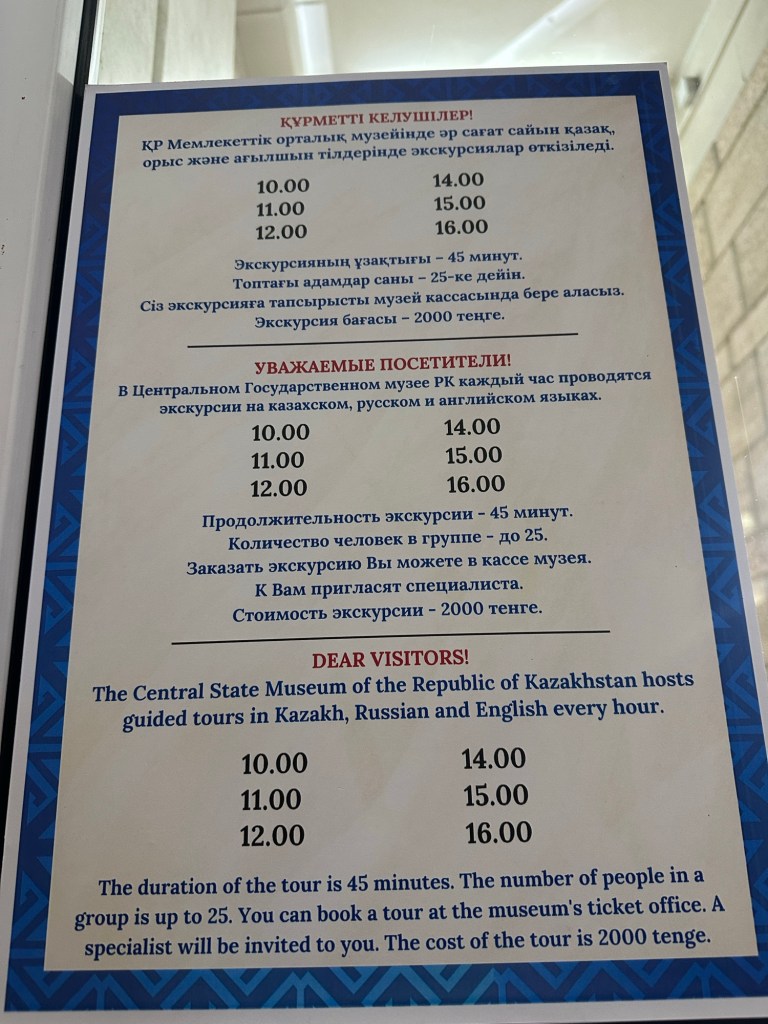
To get a better understanding of the history of Kazakhstan, we headed to the Central State Museum the next morning.

The five separate Central Asian countries did not exist until 1920, when Stalin ordered the random drawing of the borders. Prior to Russian rule, the Turkic Central Asia region, through centuries, saw Buddhist and Muslim influences, flourished during the Silk Road trading period, and suffered at the hands of Alexander the Great, Genghis Khan, and Timur.
Of all the ’Stans, Kazakhstan, the 9th largest country in the world, rich in oil and natural resources, is the largest and most economically developed Central Asian country. Before Russian annexation, the semi-nomadic Kazakh descendants of Genghis Khan roamed the steppes. With colonization in the 1880s, a wave of Russians moved into the area, and during WWII another wave of Russian minorities of Koreans, Germans, Poles, Kurds, Georgians, Tartars, Chechens were forced to resettle in Kazakhstan. After Kazakhstan gained independence in 1991 following the dissolution of the Soviet Union, many of the Russians and Germans have emigrated, leaving Kazakhstan with a Kazakh majority for the first time since the late 19th century.
 FIRE'd @ 47